Master Your Time: The Eisenhower Matrix and Pareto Principle for Peak Performance
“For the Present is the point at which time touches eternity” --C.S. Lewis
Master Your Time: The Eisenhower Matrix and Pareto Principle for Peak Performance
Introduction: The Hamster Wheel of "Busyness"
We need to have a serious talk about the word "busy."
In our world today, people wear "busy" like a badge of honor. You ask someone how they are doing, and they say, "Oh, I am just so busy!" They say it like it is a trophy. They run around with their hair on fire, answering phones, checking emails, and rushing to meetings.
But here is the hard question: At the end of the day, did they actually get anything done?
There is a massive difference between Movement and Progress.
A hamster running on a wheel is moving very fast. It is sweating. It is working hard. But it is staying in the exact same spot.
At Larsen Family Enterprises Group and Legacy Protection Services, we don't want you to be a hamster. We want you to be a lion. Lions don't run around frantically. They move with purpose. They hunt. They rest. They are in control.
If you feel like you are working 12 hours a day but your bank account isn't growing and your business isn't building, you are likely caught in a trap. You are busy, but you are not productive.
Today, we are going to give you two powerful productivity tools to fix this. These are the secrets used by presidents, billionaires, and top CEOs to get more done in a day than most people do in a month. It is time to stop managing your time and start mastering it.
The Trap of Urgency: Firefighters vs. Architects
To understand time management, you have to understand the battle between two words: Urgent and Important.
Most people think these words mean the same thing. They don't. They are actually opposites.
1. The Urgent
Urgent things are "In Your Face." They scream for your attention right now.
A ringing phone.
A dinging text notification.
A crying baby.
A deadline that is due in 30 minutes.
Urgent things force you to react. They control you. They are loud.
2. The Important
Important things contribute to your long-term mission, your values, and your biggest goals.
Planning your week.
Exercising to stay healthy.
Learning a new script for your business.
Spending quality time with your kids.
Important things do not scream. They sit quietly in the corner. They require you to be proactive.
The Problem:
In his famous book The 7 Habits of Highly Effective People, Stephen Covey explains that most of us are addicted to urgency. When we solve a quick problem (like answering a text), our brain gets a little hit of dopamine. It feels good to check a box.
So, we spend all day putting out fires (Urgent things) and we ignore the blueprints of our future (Important things).
We become Firefighters. We run from crisis to crisis, hose in hand, never building anything new.
But successful people are Architects. They spend their time designing and building so that the fires never start in the first place.
If you want to succeed in time management for entrepreneurs, you have to stop letting the loud things bully the important things.
The Eisenhower Matrix: Do, Decide, Delegate, Delete
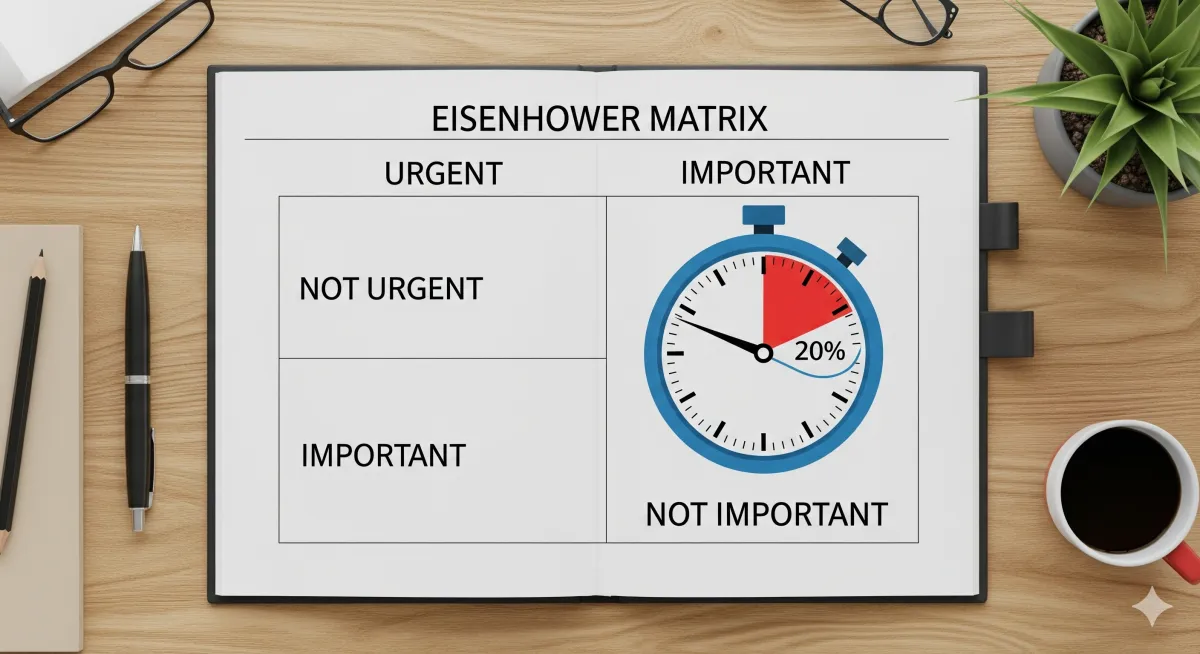
How do we break this addiction to urgency? We use a tool called the Eisenhower Matrix.
It is named after Dwight D. Eisenhower. He was a 5-Star General during World War II and later became the President of the United States. He was one of the most productive men in history. He had a secret: He categorized every single task into four boxes (or Quadrants).
Let’s look at this detailed Eisenhower Matrix explanation so you can apply it to your life immediately.
Quadrant 1: The Box of Necessity (Urgent & Important)
The Rule: DO IT NOW.
Examples: A medical emergency, a client whose policy is cancelling today, a tax deadline tomorrow, a car breakdown.
The Vibe: Stress. Burnout. Crisis mode.
The Reality: You have to spend time here sometimes. Life happens. But if you live here every day, you will burn out. You cannot build a legacy in panic mode.
Quadrant 2: The Box of Quality (Not Urgent & Important)
The Rule: DECIDE (Schedule it).
Examples: Strategic planning, recruiting new agents, exercising, reading books, building relationships, date night.
The Vibe: Growth. Control. Balance. Peace.
The Reality: This is where Success lives. This is the "Zone of the Architect." These tasks don't nag you, so you have to fight to make time for them. If you want to be a wealthy Primerica leader, you must try to spend 50% or more of your time here. This is where you prevent the fires of Quadrant 1.
Quadrant 3: The Box of Deception (Urgent & Not Important)
The Rule: DELEGATE.
Examples: Most meetings, most emails, interruptions from coworkers, other people's problems, a phone call that could have been a text.
The Vibe: "I'm so busy!" (But achieving nothing).
The Reality: This is the most dangerous box. It feels like work, but it isn't moving the needle. Ideally, you want to get someone else to do these things. If you are a new agent and can't hire help yet, your "Delegate" strategy is to say "No." Turn off your notifications. Do not let other people's urgency become your emergency.
Quadrant 4: The Box of Waste (Not Urgent & Not Important)
The Rule: DELETE.
Examples: Mindless scrolling on TikTok, binge-watching TV shows you've already seen, gossip, video games, sorting junk mail.
The Vibe: Laziness. Escapism. Regret.
The Reality: We all need a break sometimes. But if you spend 4 hours a day here, you are throwing your life in the trash. Delete the apps. Cancel the habits.
The Goal:
Most people bounce between Quadrant 1 (Stress) and Quadrant 4 (Escape). They get stressed, so they hide. Then they get behind, so they get stressed again.
Your goal is to live in Quadrant 2.
The Pareto Principle: The Magic of 80/20
Now that you have your buckets, how do you know which tasks are truly the "Important" ones?
We use the Pareto Principle, also known as the 80/20 Rule.
This rule was discovered by an Italian economist named Vilfredo Pareto. He noticed a weird pattern in his garden: 20% of the pea pods produced 80% of the peas.
He looked around the world and saw it everywhere:
20% of the people owned 80% of the land.
20% of customers create 80% of the sales.
20% of the carpet gets 80% of the wear and tear.
Here is how it applies to you:
20% of your activities create 80% of your results.
This is a life-changing concept. It means that most of what you do does not matter.
Let’s look at a sales business like Primerica. You might do 10 different things in a day.
Organize your desk.
Check email.
Design a business card.
Talk to a teammate about sports.
Call a prospect.
Sit down with a client.
Review files.
Clean the office.
Ask for a referral.
Check social media.
Out of those 10 things, only 3 of them (The Top 20-30%) actually make you money or help a family.
Calling a prospect.
Sitting with a client.
Asking for a referral.
Everything else is just "busy work."
Many agents spend 8 hours a day on the "Bottom 80%." They organize their files perfectly. They have the cleanest desk in the world. But they make zero money.
Successful agents ignore the Bottom 80% and obsess over the Top 20%. They know that one hour of "Face-to-Face" time is worth ten hours of "Desk Organization" time.
In his book The 4-Hour Workweek, Tim Ferriss talks about extreme elimination. He suggests asking yourself: "If I could only work 2 hours today, what would I do?"
The answer to that question is your Top 20%. That is your "Important" work.
Application: How to Audit Your Week
Information without action is just entertainment. Let’s put these tools to work right now. I want you to perform a Time Audit on your life.
Step 1: Track Your Time
For the next 3 days, I want you to carry a small notebook. Every 30 minutes, write down exactly what you did. Be honest. If you spent 30 minutes looking at memes on Instagram, write it down. If you stared at the wall, write it down.
Step 2: The Matrix Test
Look at your list. Put a number (1, 2, 3, or 4) next to every single task based on the Eisenhower Matrix.
How many 4s do you see? (Time wasters).
How many 3s? (Distractions).
How many 2s? (Strategic building).
Step 3: The 80/20 Cut
Circle the top 2 or 3 activities on your list that actually made you money or moved you closer to your 5-year vision.
Everything else? That is the "gravel." The circled items are the "gold."
Step 4: The New Plan
Next week, block out time for your Quadrant 2 / Top 20% tasks first.
Schedule your prospecting time in pen.
Schedule your study time in pen.
Schedule your family date night in pen.
Treat these appointments as sacred. If you wouldn't cancel on a doctor, don't cancel on your success. Fill in the rest of the time with the other stuff (or better yet, delete the other stuff).
Conclusion
Time is the great equalizer. You might not have the same money as a billionaire. You might not have the same education. You might not have the same connections.
But you have the exact same amount of time.
You have 24 hours. Elon Musk has 24 hours. Your RVP has 24 hours.
The difference between a struggling person and a successful person is not how much time they have. It is how they treat that time.
Stop giving your precious life away to urgent, unimportant things. Stop letting the world dictate your schedule. Use the Matrix. Use the 80/20 Rule.
Take back control of your clock, and you will take back control of your future.
