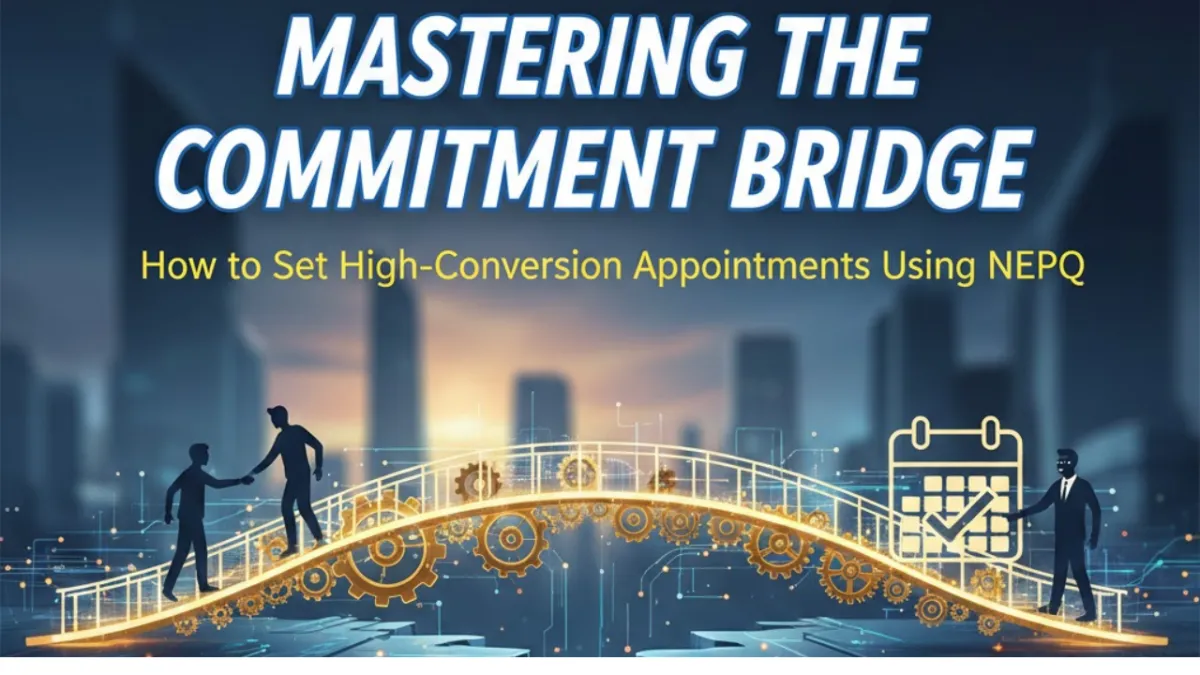
Mastering the Commitment Bridge: How to Set High-Conversion Appointments Using NEPQ
“Engaging people is about meeting their needs — not yours.” -- Tony Robbins
Introduction: The Gap Between Interest and Commitment
In the high-stakes arena of financial services, there is a recurring phenomenon that separates the top-tier producers from those who struggle to keep their calendars full. It is the "Ghosting Gap." You’ve had a great prospecting call, the rapport was high, the prospect seemed genuinely interested in a life insurance policy or a recruiting opportunity, and then—silence.
For many agents within the Legacy Protection Services and Larsen Family Enterprises Group, the hardest gap to cross is moving a prospect from "that sounds interesting" to a firm commitment: "I will see you Tuesday at 6:00 PM."
To build a truly independent and self-reliant business, you must move away from the "pushy salesperson" archetype. Instead, you must become a high-level problem solver. By using Neuro-Emotional Persuasion Questioning (NEPQ), you aren't just selling a product; you are leading a prospect to realize that their current financial status quo is a risk they can no longer afford to take. This lesson focuses on the "Commitment Bridge"—the psychological framework required to move a "won" prospect into the first appointment or a Kitchen Table Presentation (KTP).
The Psychology of the "Neutral Ask"
Most agents lose the appointment because they trigger "sales resistance" too early. When you sound eager or desperate to "get in the door," the prospect’s natural defense mechanism kicks in. They feel the pressure, and even if they have a problem, they would rather deal with the problem than deal with a "salesman."
NEPQ teaches us to use a Neutral Disposition. This means you are "biasedly detached." You know you can help them, and you are biased toward their success, but you are detached from the outcome of the phone call. This authority-based approach actually draws the prospect toward you. When you demonstrate that you are willing to walk away if the fit isn't right, you become the prize, not the pursuer.
Independence in this business starts with the realization that you are the one with the solution. You are not asking for a favor; you are offering a lifeline.
Step 1: The Summarization Pivot – Proving You Listened
Before you ask for the appointment, you must prove you were listening during the prospecting phase. This is where you mirror their "pain" back to them. In NEPQ, this is called the Summarization. If you skip this, the prospect feels like you are just following a script. If you do it well, they feel "felt."
Keywords: Financial services appointment setting, NEPQ for recruiting KTPs
Consider a prospect, "John," who mentioned he’s worried about his family’s safety.
Agent: "John, based on what you mentioned earlier about your current neighborhood feeling less secure and your concern that your family wouldn't have a plan if you weren't there tomorrow... it sounds like you're looking for a way to gain some real certainty for their protection. Is that fair to say?"
By getting the "That’s right" or "Yes," you have successfully bridged the gap from a casual chat to a serious business discussion. You have validated their feelings, which lowers their guard.
Step 2: Uncovering the Gap with Problem Awareness
You cannot set a KTP if the prospect thinks they are doing "fine." Comfort is the enemy of the appointment. You must use NEPQ questions to help them discover their own gaps.
For Product Appointments (Insurance/Securities/Gateway)
"John, what happens to the house if the primary income stops tomorrow? Have you guys factored that in, or have you just been hoping for the best?"
This is a Problem Awareness Question. It forces the prospect to look at the "monster under the bed." If they answer, "We haven't really thought about it," you have found the Gap.
For Recruiting KTPs
"If you stay at the current job for another five years, does that actually get you closer to the time-freedom you said you wanted, or does it just keep you on the same treadmill?"
This helps the prospect realize that their current "success" at a job is actually a long-term failure for their family. They are now mentally prepared for a solution.
Step 3: The Commitment Question – The "Ask" Without the Pressure
This is the bridge itself. In the Larsen Family Enterprises Group culture, we believe in empowering the client to choose their future. We don't "close" them; we allow them to "commit" to themselves.
Key Phrases: "Would it be appropriate..." or "Are you against..."
"Would it be appropriate to set aside 20 minutes on Tuesday evening to walk through a strategy that actually addresses that gap, or would you prefer to just leave things as they are for now?"
Notice the "or." By giving them the option to "leave things as they are," you remove the pressure. Ironically, this makes them more likely to say yes because nobody—absolutely nobody—wants to stay in a "broken" or "dangerous" situation once they've admitted it exists.
Step 4: The Kitchen Table Presentation (KTP) Prep
An independent business owner doesn't just "show up." They prepare their client. Once the appointment is set, your authority is maintained by setting the stage and assigning "homework."
"Great, I have you down for Tuesday at 6:00. Do you have a calendar handy to jot that down? Also, it would be helpful if you had your current policy or statement nearby so we aren't guessing on the numbers. Does that make sense?"
This ensures the prospect is "invested" in the meeting before you even arrive. It transforms the meeting from a "sales pitch" into a "consultation."
The Power of Tonality: The Invisible Framework
While the words of NEPQ are powerful, your tonality is the engine. In the Larsen Family Enterprises Group, we train our agents to use a "Curious, Concerned, and Slightly Detached" tone.
Curious: Like a doctor asking where it hurts.
Concerned: Showing empathy that the problem exists.
Slightly Detached: Conveying that while you want to help, your life doesn't depend on this appointment.
When you master the tone, the prospect feels safe. They feel like they are talking to a professional who has their best interests at heart, rather than a hunter looking for their next meal.
Overcoming the "Ghosting" Phenomenon
Why do people ghost? Usually, it's because the "Value" of the appointment did not outweigh the "Inconvenience" of the appointment. By using the Commitment Bridge, you are shifting the scales. You are making the problem so clear that the inconvenience of a 20-minute Zoom call or a kitchen table visit seems like a small price to pay for peace of mind.
If a prospect hesitates, do not push. Pull back.
"It sounds like you’re not quite sure if fixing this is a priority right now. Should we just put this on the back burner for a few months and see if the situation improves on its own?"
This "Negative Reverse" often causes the prospect to defend why they do need to meet now.
Implementing Gateway Products as the "Hook"
Sometimes, a full financial plan feels "too big" for a first appointment. This is where your Gateway Products—Vivint, Prepaid Legal, ID Theft Defense, or Answer Financial—become invaluable. These are low-friction entries into the client’s household.
"John, before we even dive into the long-term wealth stuff, would you be against us looking at your current auto and home rates through Answer Financial? Most people find they’re overpaying by $500 a year. Would it be worth 10 minutes to see if we can find that extra cash for your family?"
Setting an appointment for a Gateway Product is often easier than a full KTP, but it serves the same purpose: it gets you "to the table." Once you have saved them money or protected their home, the "Commitment Bridge" to the larger financial services becomes much shorter.
The Path to Mastery and Independence
Success in this business is not a matter of luck. It is a matter of mastery. The agents who represent Legacy Protection Services with the most success are those who have moved beyond "winging it." They have studied the psychology of human interaction. They understand that every word and every question serves a purpose.
By mastering the Commitment Bridge, you are taking control of your business. You are no longer at the mercy of a prospect's whim. You are leading the dance. This level of competence leads to a sense of self-reliance and confidence that no "sales script" can ever provide.
Conclusion: Building Your Legacy
You are building more than a business; you are building a legacy. Every appointment you set is an opportunity to change a family’s trajectory. When you use NEPQ to set those appointments, you are doing so with integrity, authority, and professional grace.
You have the tools. You have the framework. Now, it is time to engage in the process. Practice the summarization. Perfect the neutral ask. And never forget that you are the one offering the solution to the problems that keep your prospects awake at night.
CTA: Ready to take your business to the next level? Join our masterclass: [How to use NEPQ to grow your sales in your Financial Services business] and start setting appointments like a pro.
Internal Reflection Exercises for the Learner
The Mirror Test: Record yourself asking a "Neutral Ask" question. Do you sound like you're asking for a favor, or do you sound like a consultant?
The Gap Identification: List three prospects you currently have. What is the specific "Gap" for each one? If you don't know, what question will you ask to find it?
The Gateway Pivot: Which Gateway Product (Vivint, Legal, etc.) feels most natural for you to use as a "Bridge" into a new household?
© 2026 Legacy Protection Services & Larsen Family Enterprises Group. All Rights Reserved. Built for Independent Business Owners.
