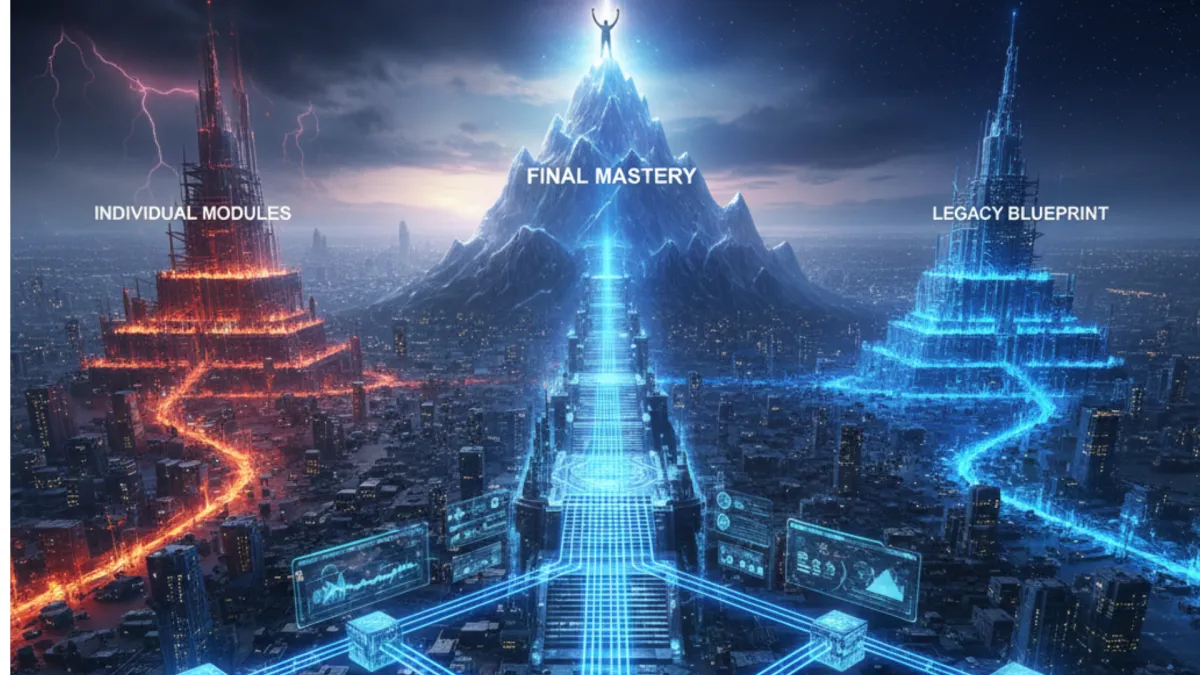
The Architecture of the Blueprint: Synthesizing the Triad for Final Mastery
"Success is a collection of individual victories; legacy is the architecture that holds them together." --Jeanette Larsen
Introduction: The Moment of Synthesis
You have spent the duration of this journey building the individual components of a Master’s life. You have the Visionary Fire from Module 1, the Strategic Rigor from Module 2, the Execution Engine from Module 3, and the Leadership Sovereignty from Module 4. However, a collection of powerful parts is not yet a machine. A pile of bricks is not yet a cathedral. To become a Legacy Architect, you must now perform the Final Synthesis.
The Legacy Blueprint is the master document of your existence. It is the integration of every skill, character trait, and tactical protocol you have developed into a single, cohesive architecture of significance. It is the bridge where your personal "Daily Decree" meets your systemic "Eternal Decree." In this final instructional phase, we guide you through the process of welding these four modules together, ensuring that your life moves with a unified purpose and an unstoppable momentum. This is the moment where you move from "Learning" the Triad to "Certifying" your mastery of it.
Component 1: The Visionary Anchor (Synthesizing Module 1)
The Blueprint begins with the Visionary Anchor. In Module 1, you identified your Life Purpose and defined your "North Star." In the synthesis phase, you must now scale that purpose from an individual ambition to a generational mission.
1. Defining the 50-Year "Why"
Your Visionary Anchor is the fixed point around which the entire legacy rotates. In the Blueprint, this must be stated with absolute clarity. You must ask: Is this purpose large enough to justify 50 years of institutionalized effort? A purpose that only serves your personal comfort is a goal; a purpose that solves a systemic problem or creates permanent value for others is a legacy.
2. The Identity Bank Alignment
The Blueprint must document the "Identity Bank" of the legacy. Just as you built your own character traits, you must define the character of the legacy itself. Does the legacy stand for Reliability? For Innovation? For Integrity? This anchor ensures that as the legacy grows and pivots, its "Soul" remains consistent with the original fire you ignited in Module 1.
Component 2: The Strategic Map (Synthesizing Module 2)
Next, you integrate the Planning module. In your Blueprint, you translate the "Gantt Charts" and "Milestones" of your individual goals into Generational Successions. This is where your Organization skills are applied to the timeline of a lifetime.
1. The Successive Horizons
A Legacy Blueprint does not just look at next year; it maps out three distinct horizons:
The 10-Year Infrastructure: What systems, capital, and organizational structures must be built to support the vision?
The 25-Year Leadership Horizon: Who are the successors and "Finishers" who will be running the engine?
The 50-Year Significance Horizon: What is the ultimate state of the world because of your contribution?
2. Strategic Resource Allocation
The Blueprint must detail how your current Success (your professional achievements and revenue) serves your Significance. You are mapping the flow of resources from "Growth" to "Impact," ensuring that your execution engine is always fueled and that your planning is grounded in the physics of reality.
Component 3: The Execution Engine (Synthesizing Module 3)
The Blueprint is not a static document; it is a living machine. This section documents the Protocols of Momentum—the systemic version of the skills you mastered in Module 3.
1. The Systemic Pivot Protocol
In Module 3, you learned to pivot your personal plan when you hit friction. In the Blueprint, you architect the Systemic Pivot. How will the organization or family legacy detect market shifts or social changes? What is the protocol for changing the "How" without abandoning the "Why"? This ensures the legacy is Anti-Fragile—able to thrive on the very chaos that destroys drifting institutions.
2. The Accountability Infrastructure at Scale
A legacy without accountability is a legacy in drift. Your Blueprint must include the External Stakes and Reporting Rhythms that keep the mission on track. This includes the "Legacy Calibrations" mentioned in Lesson 4.1—the formal audits where the system’s progress is measured against the Eternal Decree. You are taking the "Sunday Calibration" and making it an institutional law.
Component 4: The Sovereign Seal (Synthesizing Module 4)
The final layer of the Architecture is the Sovereign Seal. This is the integration of the Mastering Destiny traits—Radical Ownership and Strategic Sovereignty.
1. The Guardian Protocol & Governance
As established in Lesson 4.1, the Blueprint must name the Board of Sovereignty. It must detail the "Veto Powers" and the "Guardian Selection Process." This is the "Lid on the Jar"—the mechanism that ensures the integrity of the vision is protected from visionary drift. It is the application of Critical Thinking to the governance of the future.
2. The Mentorship Mandate & Succession
The Blueprint must document the Leadership Pipeline. It must define how "Finisher Seeds" are identified and how the Success Triad curriculum is taught to the next generation. A legacy is only as strong as its stewards; your Blueprint is the training manual for those stewards.
The Synthesis Audit: Checking for Structural Integrity
Before your Blueprint is submitted for Triad Mastery Certification, it must pass the Structural Integrity Audit. You must use your highest level of Critical Thinking to ensure there are no "Fractures of Logic" in the synthesis.
1. The Alignment Check
Does every systemic SOP and every financial allocation in the Blueprint lead directly back to the Visionary Anchor? If there is a disconnect—if you are building a system that doesn't serve the purpose—you must pivot the plan before you seal it.
2. The Dependency Check
Is the Blueprint dependent on your heroic effort, or can it run autonomously? A Master of Destiny builds a system that eventually makes them redundant. If the legacy collapses without your direct hand on the wheel, it is not yet an architecture; it is still a job.
3. The Finish Line Check
Is the "Seal of Completion" clearly defined for each generational horizon? A "Finisher" knows exactly what the victory looks like. Your Blueprint must define the "Success Criteria" for your significance so that future generations know when they have won.
Conclusion: From Execution to Architecture
The Legacy Blueprint is more than a document; it is a Vow of Finality. By completing this synthesis, you are applying the final "Seal of the Finisher" to your identity. You are no longer someone who is "trying" to be successful; you are the architect of a permanent force in the world.
The Success Triad began as a way for you to gain control of your time and your results. It ends here, as a way for you to gain control over your impact and your legacy. You have bridged the gap between your imagination and a reality that will outlast you. You have operationalized your destiny.
Architect the Blueprint. Synthesize the Triad. Claim your Mastery.
